If you run a subcontracting crew, time theft is probably costing you money right now. You just can’t prove it.
That’s the part that makes it so frustrating. You know the numbers don’t always add up. You know Friday timecards don’t always match what the foreman reported. But without a clear record of who was where and when, you’re arguing gut feeling against paperwork.
This post covers what time theft actually looks like on a subcontractor job site, why it’s harder to catch than most owners expect, and what you can do about it.
What Time Theft Actually Looks Like on a Job Site
Time theft doesn’t always look like someone sitting in their truck for two hours doing nothing. On construction sites, it usually shows up in smaller, harder-to-see ways:
Buddy punching. One worker clocks in for another who hasn’t arrived yet. On paper, the whole crew was on site at 6:30 AM. In reality, three guys showed up at 7:15.
Early clocking out. Workers clock out at the end of the day before they’ve actually finished cleaning up and secured the site. This happens most at end of week.
Inflated hours. A worker records 9 hours for a day that was really 7.5. Not dramatic enough to flag anyone’s attention, but it adds up across a full crew over a full month.
Rounding abuse. Some time systems round to the nearest 15 minutes. Workers know this and time their punches accordingly. A crew of 15 people each getting an extra 15 minutes a day adds up to almost 600 hours a year.
Travel and break time. Time spent traveling to the yard to pick up materials gets recorded as job time. Breaks run long. No one checks.
None of these feel like theft when they’re happening. But the math is real.
Why Subcontractors Have It Harder Than Most
General contractors have superintendents on site watching over multiple trades. You, as the sub, are often working across multiple job sites simultaneously. Your foreman is managing the work, not auditing timecards.
The field and the office are operating on different information. Your foreman knows what actually happened today. Your office knows what the timecard says happened. Those two things are not always the same, and the gap between them is where the money goes.
Paper timesheets make it worse. When a foreman fills out a sheet at the end of the week from memory, there’s no reliable record of what happened on Tuesday. When workers self-report hours, there’s no check on accuracy. When everything comes in on Friday, it’s too late to verify anything.
What Fixing It Actually Takes
The goal isn’t to treat your crew like suspects. Most workers aren’t maliciously stealing from you. The goal is to have an accurate, real-time record that removes ambiguity for everyone.
Here’s what actually changes the equation:
GPS-verified clock-ins. When a worker can only clock in from the job site, buddy punching stops. There’s no argument about when someone arrived because the GPS timestamp is the record.
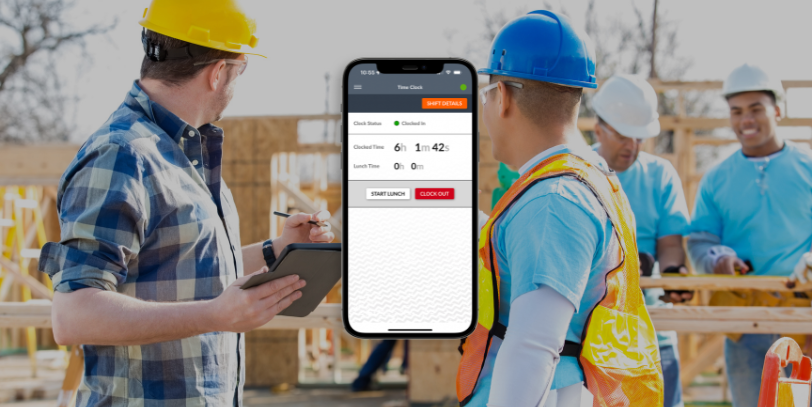
Mobile time tracking on the worker’s phone. Crew members clock in and out themselves, in real time, from wherever they’re working. No more end-of-week timecard reconstruction.
Daily reports tied to time data. When a foreman is logging production alongside time, inconsistencies surface naturally. If three workers were supposedly on site for 8 hours but the production log shows two hours of work, someone asks a question.
Visibility for the office. When office staff can see hours as they’re being recorded instead of getting a paper stack on Friday, they can flag problems before payroll runs.
The Real Cost of Not Fixing It
Here’s a way to calculate it yourself: take your average crew size, multiply by an estimated 30 minutes of lost time per day per worker, multiply by your average hourly labor cost, and multiply by 250 working days a year.
A crew of 20 workers, each losing 30 minutes a day, at $35/hour, costs over $87,000 a year in unverified labor.
The number is usually larger than people expect.
How CrewTracks Solves This
CrewTracks is built for subcontractor field crews. Workers clock in and out from their phones, GPS-verified to the job site. Foremen log production and daily reports in the same app. The office sees everything in real time.
That means:
- Buddy punching is gone. You can only clock in from where you’re supposed to be.
- Hours are recorded as they happen, not reconstructed on Friday.
- Foreman production logs create a second layer of accountability without anyone playing cop.
- Payroll runs from accurate data, not guesswork.
It also removes the friction from the foreman’s side. Daily reports that used to take an hour of paperwork take a few minutes on a phone. That means they actually get done.
If you’re not sure what your crew’s actual hours look like versus what your timecards say, that gap is worth looking at. Talk to us about how CrewTracks works for crews like yours.